


Debt collection for doctors: When the debtor is your patient

Imagine a debtor who will be sitting in your waiting room again next week. Someone who has trusted you for years and whose family are also among your patients.
And whose outstanding medical bill you may only pass on to a debt collection agency with his consent, because it too is subject to medical confidentiality.
That is exactly the starting point when a medical practice has to collect money. Debt collection for doctors is a special case and works differently than in most industries. Below we explain why that is and how the industry deals with it.
Outstanding private invoices are commonplace, not the exception
For those with statutory insurance, billing is handled through the Association of Statutory Health Insurance Physicians, and the patient does not receive an invoice. It is different for private patients and self-payers. Here the practice issues the medical bill directly to the patient.
The patient pays it initially themselves and then submits it to their private health insurance, which reimburses them for the amount. However, this procedure has a downside, because whether and when the money reaches the practice depends solely on the patient.
And that does not always work. In almost every practice a portion of private invoices initially remains unpaid.

Many outstanding invoices are not true defaults
The good news is in the word “initially”, because very few of these patients are refusing to pay. Usually the invoice was simply forgotten, lost in a stack of papers, or the patient waits for reimbursement from their insurer before transferring the payment.
This makes a big difference for handling these outstanding items, because most cases can be resolved with a simple reminder.
In a medical practice, more than the outstanding amount is at stake with debt collection
In e-commerce there is usually no personal relationship between the company and the debtor. In a medical practice it is different; many patients have been coming for years, and often the whole family is treated. So when an invoice remains unpaid, more is always at stake than the single amount. Someone who feels offended by a reminder will, if in doubt, look for a new practice.
In addition, practices rely heavily on recommendations. New patients come through word of mouth or review portals. How a practice issues reminders therefore gets around, for better or worse.
Medical confidentiality sets clear limits
And then there is medical confidentiality. A medical bill reveals sensitive information, for example who was treated and which services were provided.
A practice must not pass such information on to third parties without further ado, not even to a debt collection agency.
The course for this is therefore already set at the start of treatment. If the patient consents, the practice may involve external service providers in billing.
Without this consent it must pursue its claims itself. In many practices the corresponding declaration is therefore already part of the paperwork for the first appointment.
A clear process from reminder to debt collection relieves the practice
When a medical bill remains outstanding, practices face a task for which everyday practice really offers no time.
In everyday practice this means concretely:
Monitor incoming payments,
keep track of deadlines and
answer queries from patients.
All of this runs alongside consultations and appointment scheduling. Added to this is a human component. Sending a reminder to someone you know personally and will greet again next week is harder for many practice teams than any other administrative task.
That is why many practices work with private medical billing agencies. They can take over the billing process from the GOÄ-compliant preparation of the invoice through sending to monitoring incoming payments. One provider in this area is, for example Doctario.
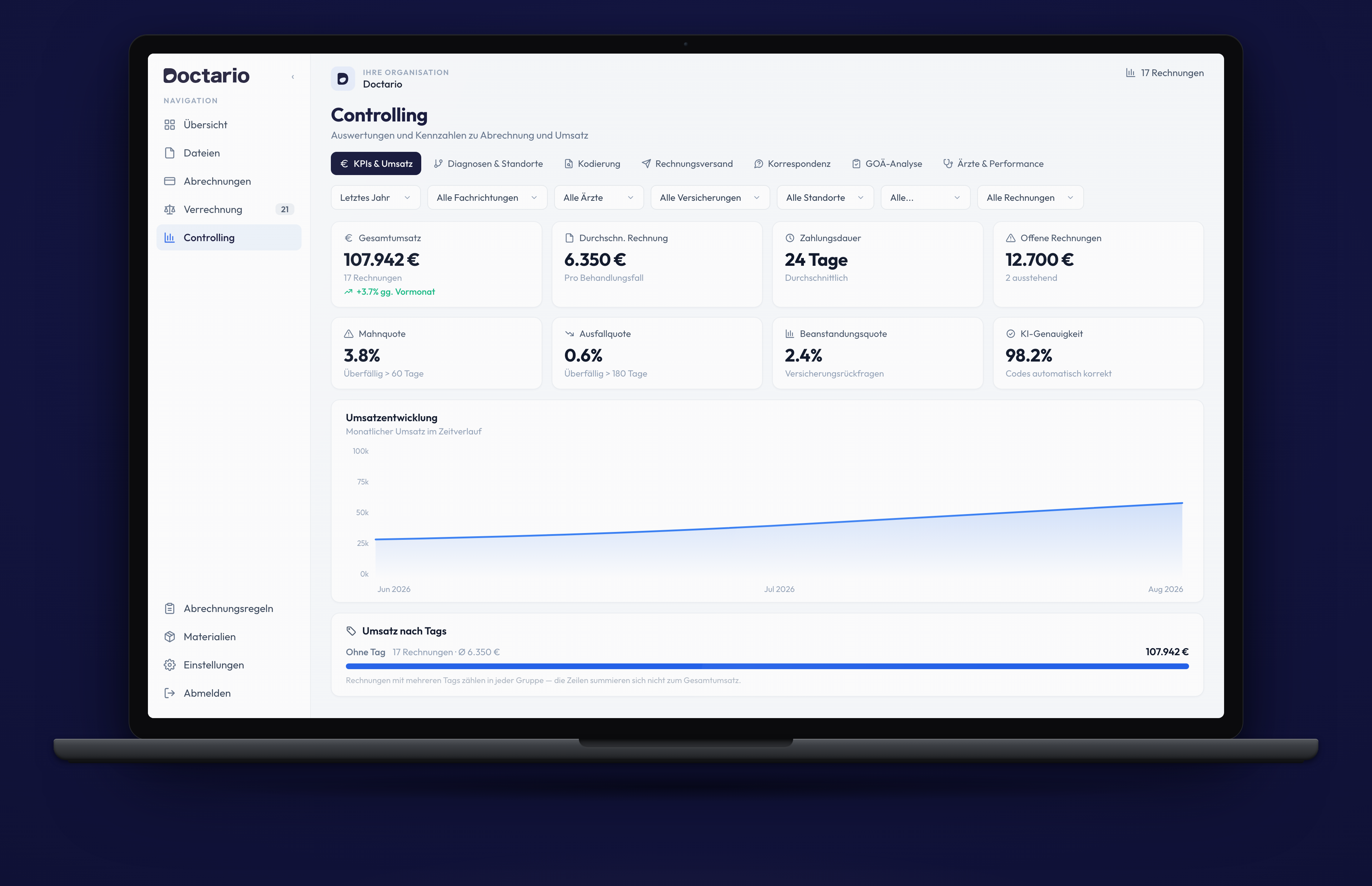 Insight into digital billing platforms such as for example Doctario.
Depending on the provider, queries from patients and objections from insurers can also be handled outside the practice. At the same time, metrics such as payment duration, dunning rate, and default rate can be monitored centrally.
For the practice, this reduces administrative effort and creates a certain distance between treatment and the payment process.
If a claim remains open despite the upstream dunning process, debt collection can follow. At Doctario, this transition takes place in cooperation with Debtist.
When an outstanding invoice becomes a debt collection case
If reminders and dunning notices have no effect, a claim becomes a case for a debt collection agency.
In healthcare this step is more sensitive than elsewhere, because with the claim a part of the patient relationship also changes the contact person. How the debt collection agency presents itself reflects directly on the practice.
A lot therefore depends on the working methods of the debt collection agency. Particularly important are:
a respectful, solution-oriented tone,
good availability and
simple payment options, such as an uncomplicated installment plan.
A debt collection agency that works like this not only recovers the claim. It also ensures that the patient remains a patient afterwards.
Why outstanding invoices particularly affect dental practices
Dental practices in particular know this issue well. Due to co-payments and self-pay services, patients here pay out of pocket particularly often. Accordingly, a clear process for dealing with outstanding dental bills is highly relevant.
Conclusion
Debt collection in healthcare is relationship management with a payment deadline. Collecting the claim is only half the task. Not losing the patient in the process is the other.
That is why a division of labor has developed in the industry, where each stage keeps the relationship in mind. With clean, transparent billing at the beginning, friendly reminders in between, and a debt collection process that remains respectful.
This basically applies far beyond healthcare. Someone who doesn't pay today can still be a good customer tomorrow, if you don't lose them in the dunning process.